On the morning after the Spring Equinox, my wife and I visited the Jefferson Memorial with dear friends as a postcard spring day unfolded around us. The cherry trees surrounding the tidal basin — those stunning ambassadors of seasonal renewal — were just beginning to open their blossoms, full of unmistakable promise. It felt like exactly the right metaphor for this moment in America.
This year, we mark 250 years of the Great American Experiment. And standing beneath that soaring rotunda, reading words carved into marble that were first scratched by candlelight with a quill pen, I found myself thinking: Thomas Jefferson was a Cultivated Leader.
Not a perfect man — history demands that we hold that tension honestly. But a cultivated one. A man who tended the soil of ideas with the same disciplined attention a farmer gives to land he intends to leave better than he found it.
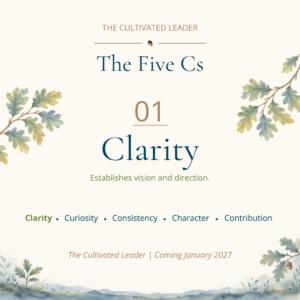
Clarity
Jefferson possessed the rare gift of distilling complexity into bedrock truth. “We hold these truths to be self-evident.” Seven words before the colon — and with them, the entire moral architecture of a new nation. Clarity is not simplicity. It is the hard-won ability to see through the fog of the moment to the principle that endures. Cultivated leaders develop this capacity not by having all the answers, but by asking the most essential questions — and refusing to rest until the language matches the conviction.
What truths do you hold self-evident? And are you expressing them with that kind of clarity?
Curiosity
Jefferson was relentlessly, insatiably curious. He was a farmer, an architect, an inventor, a naturalist, a linguist, a diplomat, a philosopher. He understood that the mind, like soil, must be turned and aerated — left fallow, it hardens. One of the inscriptions on the memorial’s walls cautions against institutions that fail to keep pace with the progress of human understanding. That warning is as alive today as it was in 1776.
Curiosity is not a luxury for leaders. It is a survival skill — and a stewardship obligation.
Consistency
Jefferson’s ideas did not emerge in a single brilliant flash. They were cultivated across decades of reading, writing, arguing, revising, and returning. The Declaration did not spring fully formed from a moment of inspiration — it grew from years of intellectual preparation.
Consistency is the discipline of showing up to the work even when no one is watching, even when the harvest feels distant. It is planting in the spring with full faith in the autumn.
Character
He staked his life, his fortune, and his sacred honour — and he meant it. That phrase, etched in the marble I touched yesterday, is not rhetoric. It is a covenant. Character is what we offer when circumstances demand more than comfort allows. For Jefferson and his fellow signers, the cost of failure was not professional embarrassment — it was their lives.
Cultivated leaders do not wait for high stakes to decide what they stand for. They decide before the moment arrives.
Contribution
Jefferson understood that his work was not for his generation alone. He was planting trees under whose shade he might never sit. The Declaration, the University of Virginia, the Louisiana Purchase — these were acts of multigenerational stewardship.
Every cultivated leader must eventually ask:
What am I building that will outlast me? What ground am I preparing for those who come after?
Our 250th Season
The Equinox is the true beginning of the growing season — the moment of perfect balance between light and darkness, between what has been and what is becoming. It felt right to be standing inside Jefferson’s memorial on precisely that morning, reading words about the balance between liberty and governance, between individual rights and collective covenant.
July 4th will be the harvest celebration. This is the planting moment.
As we approach this great national anniversary, I keep returning to the image of those cherry trees at the tidal basin — not yet at full bloom, but unmistakably alive with possibility. The Great American Experiment is not a finished product. It is a living, breathing thing that requires careful cultivation. It requires the same qualities Jefferson modeled: clarity about what we believe, curiosity about what we don’t yet understand, consistency in showing up, character when the cost is real, and contribution that looks beyond our own season.
Jefferson gave us remarkable words. The question — always the question — is what we do with them.
The ground has been prepared.
What will you plant — and how will you cultivate it?
Tempus Maximize!