Cut to Fit or Cultivated to Flourish?
Wrong Plant, Wrong Place
Every February, it happens again.
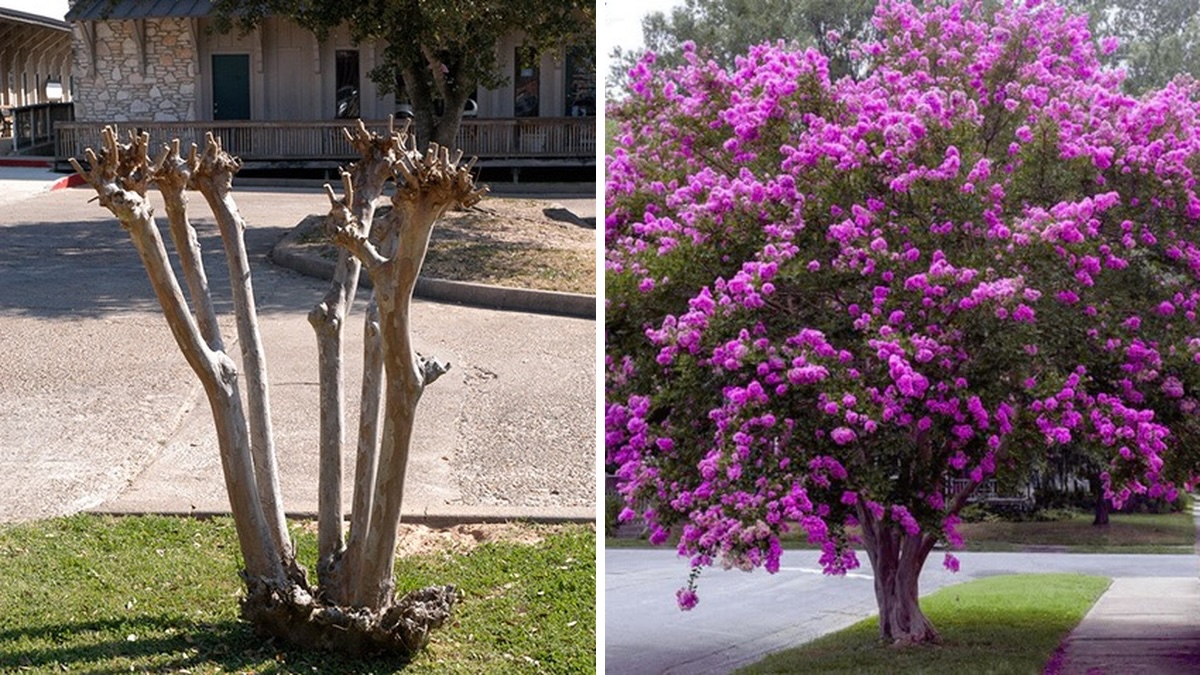
Drive any Southern neighborhood and you’ll see it: crape myrtles, hacked down to blunt, knuckled stubs. Beautiful trees, reduced to fists. Some homeowners call it maintenance. Some landscapers call it routine. Horticulturists call it something else entirely: Crape murder!
Here’s the reality. The tree was never a problem. It was mismatched to the place it was planted from the very beginning. A variety that grows up to thirty feet tall doesn’t belong tucked under a power line or wedged against a porch built for something smaller. Rather than solving that problem, they just went to work with a saw instead. The two trees pictured above reveal the difference: one reflects years of habitual cutting; the other shows what becomes possible when the right tree is placed in the right setting and cultivated according to its nature.
And every spring and summer, the tree tries to grow into its potential. Every winter, someone cuts it back down to fit a space it was never suited for in the first place. That’s not pruning. That’s a serious symptom, mistaken for a solution.
Root Cause, Not Surface Cut
This is where first principles thinking creates long-term value. What we call “management” of a blooming tree, a process, a person, or a plan, is often simply repetition disguised as thoughtful action. We do it because it was done last year. Because the neighbor does it. Because nobody actually stopped to seek out the underlying truth.
First principles thinking asks a harder question: what is fundamentally true here, stripped of habit and convention? And what could this become if we cultivate it to grow into its potential?
Three logical steps get you there.
Identify. Name the cut before you make it. What are we trimming back, out of habit, without asking why?
Deconstruct. Separate what’s actually true from what’s just tradition. Is the tree really too big, or was it simply planted in the wrong place and that fact has been habitually ignored?
Reconstruct. Based on the core truth alone, what’s the right path forward? Sometimes it’s not another cut; perhaps it’s a different tree. With people, it may be a different role, a different environment, or simply the removal of assumptions that have kept their potential constrained.
Left alone — planted in the right place, pruned gently, if at all — a crape myrtle grows into something magnificent. A graceful, multi-trunked form, with bark that peels to cinnamon and silver in winter. It becomes a spreading tree with blooms that hold, because the branches beneath them are strong enough to carry the weight.
None of that shows up if you keep cutting it back to the same knuckles every year.
I think about the people and teams I work with the same way. How often do we “prune” someone back to a familiar shape, keeping them in the role they’ve always played, under a ceiling we assumed was there, and without ever asking whether this was the right fit to begin with? How often is what looks like productive action actually just habit, applied over and over again without questioning why, or if there is a better way?
The tree isn’t the problem. The mismatch is. And no amount of annual cutting ever fixes a mismatch; it only hides it, again, until next February.
So here’s a question worth pondering:
What have you been pruning back, season after season, simply because that is what has always been done — without asking what might become if, instead, you cultivated it to flourish?
Tempus Maximize!